My Cart: 0 item(s)


First Mods for a New Ford Bronco: What I'd Actually Spend My Money On
By Brian Meyers, Founder of JcrOffroad · Published November 16, 2026
Quick answer: On a new 6th Gen Bronco, I'd start with recovery gear (and a winch if you travel alone), a good air compressor, and whatever protection your trim is missing, like rock sliders or skid plates. I'd hold off on a lift, bigger tires, and new bumpers until the trail shows you what you actually need.
If I bought a new Bronco tomorrow, I wouldn't be in a hurry to modify it.
That's probably an odd thing to hear from someone who's spent more than 20 years manufacturing aftermarket off-road parts, but Ford did a pretty good job with the 6th Gen Bronco, especially the Badlands and Sasquatch-equipped models.
The suspension is capable, the tires are decent, and depending on the trim, you've already got some good protection underneath.
Twenty years ago, buying a new Jeep meant immediately making a list of things you needed to replace. The Bronco is a different story.
We make a lot of parts for the Bronco at JcrOffroad, and there's plenty of room to improve it. But I wouldn't spend $10,000 modifying one before finding out what it can do.
Here's where I'd start.
1. Recovery Gear
Before anything else, I'd make sure I had a way to get myself out of trouble.
A recovery strap, properly rated soft shackles, a tire repair kit, and some basic tools would be my starting point. I'd also make sure I knew how to use everything.
I've been off-roading long enough to know you don't have to be doing anything particularly difficult to get stuck. Sometimes it's a muddy section of trail, a little too much snow, or a bad decision about where to turn around.
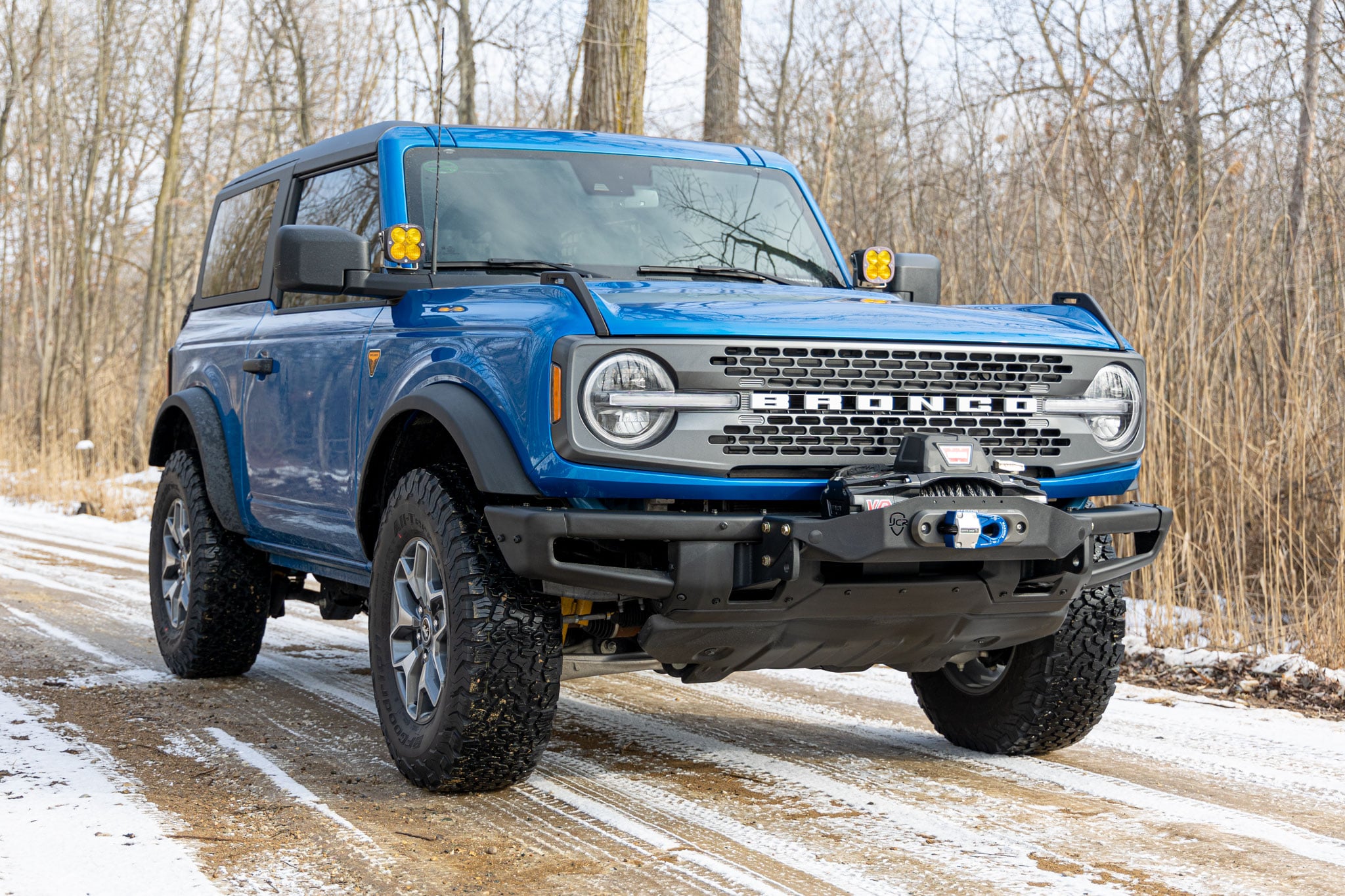
A winch would be high on my list, especially if I planned on traveling alone.
If your Bronco came with Ford's Modular Steel Bumper or Capable Bumper, we make a bolt-on winch mount that allows you to add a winch without replacing the bumper. I go into more detail in Can You Mount a Winch to the Factory Bronco Bumper?
That's where I'd spend my money first.
2. A Good Air Compressor
This might be the least exciting modification on the list, but it's something you'll use nearly every time you go off-road.
Airing down your tires makes a noticeable difference in traction and ride quality. On a long, rocky trail, it can make the difference between getting bounced around all day and actually enjoying the drive.
Of course, you need to air them back up before getting on the highway.
I prefer an onboard compressor because it's always there, but a portable one works fine. We make an ARB compressor mount for the Bronco if you want a permanent installation.
Either way, this is one piece of equipment I wouldn't leave home without.
3. Rock Sliders
If my Bronco didn't come with rock rails, this would probably be my first major piece of armor.
The rocker panels are one of the easiest places to do expensive body damage. A rock hidden in a rut or a poorly chosen line can make for an expensive afternoon.
I'd pay attention to how the sliders are mounted. Running boards and rock sliders aren't necessarily the same thing. One helps you climb into the vehicle, while the other needs to support the vehicle when it comes down on an obstacle.
We make Crusader Rock Sliders for the Bronco that provide protection and a usable step, in 2-door and 4-door versions. If you're not sure which fits yours, see 2-Door vs. 4-Door Bronco: Which Sliders and Skids Fit.
If you're planning on running rocky trails, protecting the rocker panels is money well spent.
4. Skid Plates
Depending on your Bronco's trim, Ford may have already provided some decent protection underneath. Other models leave more exposed.
I'd take a look at the engine, transmission, transfer case, and fuel tank. Those are the things I don't want to damage when I'm a long way from home.
I'm also not a big believer in adding hundreds of pounds of armor unnecessarily.
If you're regularly dragging your Bronco across rocks, heavier protection makes sense. If you're mostly driving forest roads and camping, you probably don't need a full set of heavy steel skids.
We offer individual skid plates because sometimes you only need to protect one area. Our Bronco Transfer Case Skid Plate, for example, is available in 3/16" steel at 23 pounds or 1/4" aluminum at 14 pounds.
I'd focus on protecting the vulnerable areas without adding more weight than necessary.
5. Storage and Organization
This is something I appreciate more every time I go camping.
It doesn't take long for the back of an SUV to turn into a pile of recovery gear, tools, air hoses, and camping equipment.
I like being able to find what I need without unloading half the vehicle.
A few well-placed MOLLE panels or storage compartments can make a big difference. We make several storage accessories for the Bronco, but how you organize things really depends on what you carry.
I also like having heavy equipment secured rather than bouncing around in the cargo area.
It's not the most exciting modification, but it makes the vehicle a lot more enjoyable to use.
What About Bigger Tires and a Lift?
I know a lot of people would put these at the top of their list. I wouldn't.
If you bought a Sasquatch-equipped Bronco, you've already got 35-inch tires and a capable suspension. Even the Broncos without Sasquatch are more capable than a lot of people give them credit for.
Bigger tires can improve clearance and traction, but they also add weight and affect gearing, braking, acceleration, and fuel economy.
A suspension lift can be useful, especially when accommodating larger tires, but it isn't automatically an improvement.
I've driven plenty of vehicles that rode better before someone started modifying the suspension.
Unless you're trying to overcome a specific limitation, I think Ford's factory setup is a pretty good place to be.
Should You Replace the Factory Bumpers?
It depends on which bumpers you have.
I think Ford did a good job with its Modular Steel Bumper. The removable end caps are useful, it looks good, and the factory electronics are already integrated.
If you've got one, I'd probably keep it.
If you have a plastic bumper or need more clearance, protection, or different mounting options, an aftermarket bumper starts making more sense.
We manufacture complete Bronco bumpers at JcrOffroad, but we also make accessories for the factory bumper. There's a place for both. If you're shopping, our Bronco front bumper comparison lays out how the main brands stack up.
What About Lights and Roof Racks?
Both can be useful, depending on how you use your Bronco.
If you're regularly driving trails after dark, additional lighting can make a big difference. Just pay attention to where you mount the lights and what beam patterns you're using.
Roof racks are great for bulky camping equipment, but they add weight up high and can create wind noise. Our Bronco roof rack guide covers what matters before you buy.
I like keeping as much equipment inside the vehicle as possible, but sometimes you simply run out of room.
These are the kinds of upgrades I'd make based on how I was using the Bronco rather than putting them on my initial shopping list.
The Bronco Parts I Mentioned


Frequently Asked Questions
What's the first modification I should make to my Bronco?
I'd start with recovery equipment and a good air compressor. They're useful regardless of which Bronco you own.
Does a new Bronco need a lift?
No. The factory suspension is capable, especially on Badlands and Sasquatch-equipped models.
Are factory Bronco rock rails good enough?
For a lot of people, yes. More substantial sliders can make sense for difficult rocky trails.
Should I replace the factory steel bumper?
Not necessarily. Ford's Modular Steel Bumper is a good starting point, and you can add a winch without replacing it.
Can I add a winch to the factory Bronco bumper?
Yes. Our bolt-on winch mount fits Ford's Modular Steel Bumper and Capable Bumper, so you can add a winch without replacing the bumper.
Should I upgrade to 37-inch tires?
Only if the additional clearance and capability are worth the added weight, cost, and fitment considerations.
Should Bronco skid plates be steel or aluminum?
It depends on how often you drag across rocks. Our Bronco transfer case skid weighs 23 pounds in 3/16" steel and 14 pounds in 1/4" aluminum, so aluminum saves weight for forest roads and camping, while steel suits regular hard contact.
Where I'd Start
When I started JcrOffroad, I was a college kid who couldn't afford the bumpers I wanted for my Jeep. I ended up building my own, and that eventually turned into a business.
I still remember what it was like trying to decide where to spend money on a vehicle when I didn't have much of it.
Today, I've got more than 20 years of experience designing parts and seeing what works on the trail, but my approach to off-roading hasn't changed much.
I enjoy exploring, taking my time, camping, and getting home without breaking anything.
If I bought a new Bronco, I'd start with recovery gear, a compressor, and whatever protection it was missing. Then I'd go use it.
The Bronco is already a pretty capable vehicle. You don't have to replace half of it to start enjoying it.
Related Reading
- Can You Mount a Winch to the Factory Bronco Bumper?
- 2-Door vs. 4-Door Bronco: Which Sliders and Skids Fit
- Best Ford Bronco Front Bumpers Compared
- Best Ford Bronco Roof Racks: What Matters Before You Buy
Brian Meyers
Founder, JcrOffroad
