My Cart: 0 item(s)


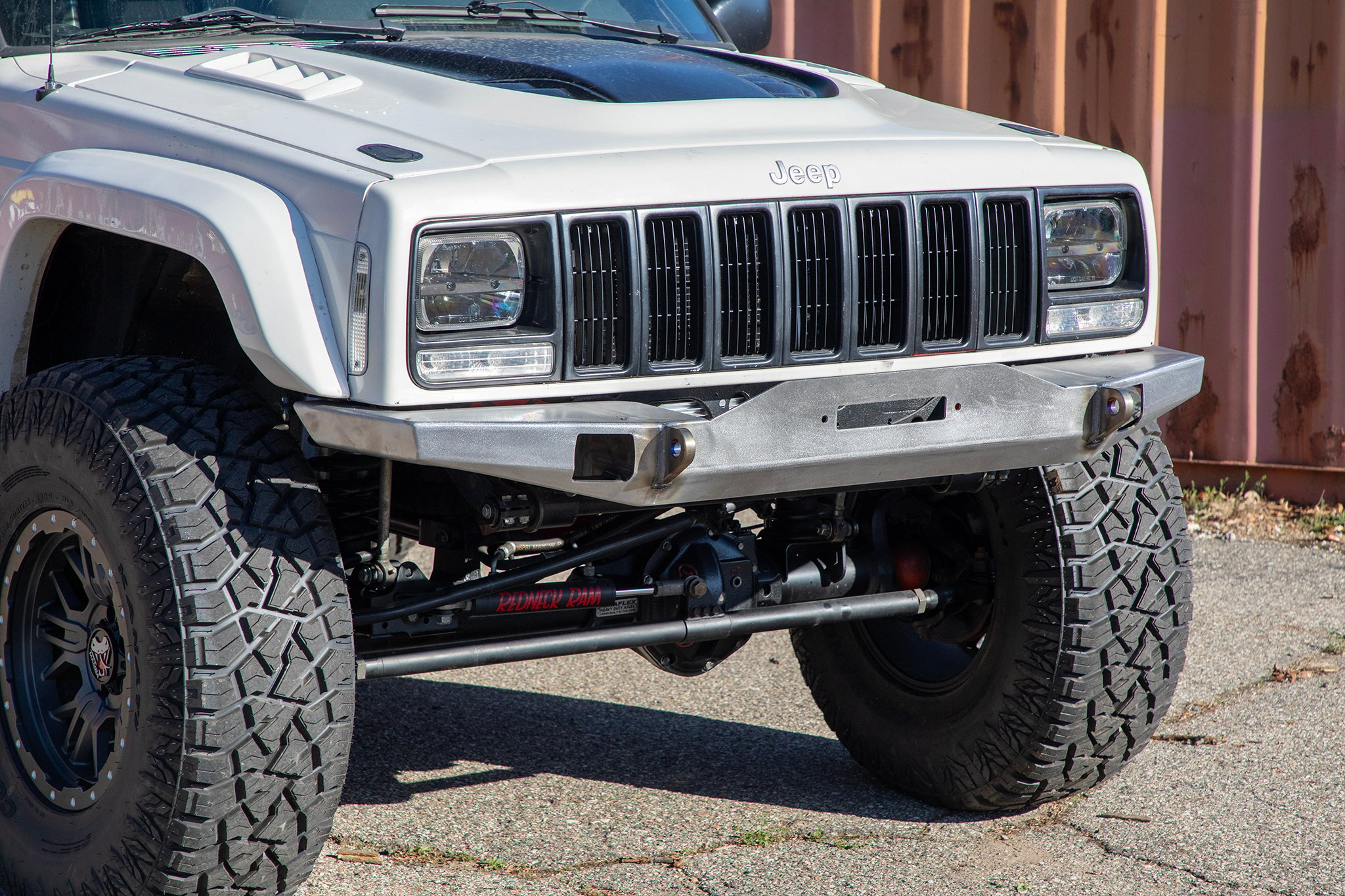
Jeep Cherokee XJ DIY Bumper Kits (1984-2001): Build Your Own Without Starting From Scratch
By Brian Meyers, Founder of JcrOffroad · Published November 18, 2026
Quick answer: If you have the equipment and welding experience to build your own bumper, our JcrOffroad DIY bumper kits give you a head start. We handle the design, CAD work, and laser cutting. You handle the bending, welding, finishing, and final assembly. We offer a standard front bumper, a front winch bumper, and a rear bumper designed to accept a swing-out tire carrier. All three fit the 1984-2001 Jeep Cherokee XJ.
There's Something Different About Building Your Own Bumper
When we started JcrOffroad, we weren't a big manufacturing company with expensive equipment and a building full of employees. We were young guys who enjoyed Jeeps and wanted to make parts for them.
I started building bumpers because I couldn't afford to buy the ones I wanted. Learning to fabricate was a way to get something better for my own Jeep without spending money I didn't have.
That eventually turned into a business.
More than 20 years later, we have engineers, laser cutting equipment, forming equipment, welding fixtures, and production systems that would have been hard to imagine when we started.
But I still understand the satisfaction of building something yourself.
That's what I like about our DIY bumper kits. They give people an opportunity to build their own bumper without having to figure out every dimension, angle, and mounting point from scratch.
We do the design work and cut the steel. You get to do the fabrication.
It's a good middle ground between buying a finished bumper and starting with a pile of raw material.
What Is a DIY Bumper Kit?
A DIY bumper kit is a collection of pre-cut steel components designed to be assembled and welded into a finished bumper.
Instead of purchasing raw steel, creating your own drawings, measuring every angle, and cutting each piece, you start with parts that have already been designed to fit together.
Our XJ DIY kits are laser cut from 3/16-inch steel.
The standard front bumper includes perforated bend lines that make it possible to form the pieces with hand tools before welding.
The important distinction is that these are not finished bumpers. They arrive as raw steel components and require fabrication before they can be installed and used.
You'll need to bend and fit the pieces, weld the assembly, check the finished fit, and apply your preferred coating.
You're still building a bumper. We're simply removing much of the design and cutting work.
JCR Cherokee XJ DIY Bumper Options
We offer three main DIY bumper configurations for the XJ.
- Standard front: Front protection without an integrated winch mount, $329 regular starting price
- Front winch: Builds that need a winch, $349 regular starting price
- Rear tire-carrier-ready: Rear protection with provisions for a swing-out carrier, $389 regular starting price
These are regular listed starting prices, before any temporary promotions. Additional accessories and finishing materials are separate.
All three kits are designed for two-door and four-door Cherokee XJs from 1984 through 2001.
Standard Front DIY Bumper: Keep It Simple
The JCR XJ DIY Front Bumper is the most straightforward option in the lineup.
It's built from laser-cut 3/16-inch steel and includes perforated bend lines to help with forming the bumper.
The kit also includes machined 3/4-inch recovery tabs with 1-inch through holes.
This is the bumper I'd consider for someone who wants to replace the factory bumper with something more substantial but doesn't need an integrated winch mount.
It's also a good starting point for someone who wants to add custom tubing or modify the appearance.
We offer optional DIY tubework, but it's not included with the basic bumper kit.
My take: If you're building a lightweight trail Cherokee and don't plan to run a winch, I'd start here. You get a straightforward bumper design with room to make it your own.
Front DIY Winch Bumper: Build Around Recovery
The JCR XJ DIY Front Winch Bumper is designed for owners who want to incorporate a winch into their build.
Like the standard front kit, it uses laser-cut 3/16-inch steel.
The winch mounting plate accommodates the common 10-by-4.5-inch foot-mounted winch bolt pattern.
That's an important detail because a winch bumper needs more than an opening in the front for a fairlead. The winch must be mounted to a structure capable of transferring recovery forces into the vehicle.
On an XJ, the mounting system deserves particular attention because of the unibody construction.
We recommend pairing the front DIY bumpers with our XJ Unibody Tie-In Kit.
A winch can place substantial loads on the front of the vehicle. The bumper and its mounting system need to be properly assembled, installed, and inspected before recovery use.
My take: If you're building a Cherokee for remote trails, I'd seriously consider the winch version. Even if you don't install a winch immediately, deciding on a winch-capable design during the initial build is easier than redesigning the bumper later.
Rear DIY Bumper: Build Your Own Tire-Carrier Setup
The JCR XJ DIY Rear Bumper is designed for owners who want rear protection with the option of adding a swing-out tire carrier.
It's constructed from laser-cut 3/16-inch steel and includes receiver hitch tubing.
It also has mounting provisions for our DIY tire-carrier system.
The tire carrier itself is sold separately, so you can choose how much of the project you want to take on.
For someone building an XJ with larger tires, an exterior spare tire carrier can make a lot of sense. It frees up cargo space inside the Cherokee and keeps the spare accessible.
But adding a carrier also introduces more fabrication work. You're dealing with the weight of the spare tire, the swing-out mechanism, the latch, and the loads created when driving rough trails.
Those details matter just as much as the bumper itself.
My take: If you're planning to carry a full-size spare outside the vehicle, I'd build the rear bumper with the carrier in mind from the beginning.
What About a Complete Rear Bumper and Tire Carrier Kit?
We also offer a Rear Bumper Carrier Builder Bundle for customers who want to build a more complete rear setup.
The bundle includes the DIY rear bumper and matching swing-out tire carrier, along with our Bomb Proof spindle kit and a Destaco latch.
It also includes a license plate and backup camera relocation kit, Diode Dynamics SS3 lighting, a wiring harness, and rear nut strips.
The advantage is that you're getting the major components for the project together instead of figuring out every accessory individually.
It doesn't eliminate the fabrication work. The parts still arrive unfinished, and you'll need to cut, bend, weld, assemble, and coat them.
But it gives you a more complete starting point for a rear bumper and carrier build.
How Much Welding Experience Do You Need?
This is probably the most important question in the article.
Our DIY bumper kits are not intended to teach someone how to weld.
You need to be comfortable fitting steel components, controlling distortion, and producing sound welds. That's especially important around mounting points, recovery tabs, winch mounts, and tire-carrier components.
A bumper is a structural accessory that can experience substantial forces off-road.
If you're new to welding, I wouldn't make a recovery bumper your first unsupervised fabrication project.
You can still participate in the build. There's nothing wrong with fitting the pieces yourself and having an experienced welder handle the structural welding.
I think that's a much better approach than assuming a few decent-looking weld beads are enough.
We provide assembly instructions, but the quality of the finished bumper ultimately depends on the person assembling it.
What Tools Do You Need to Build an XJ DIY Bumper?
At a minimum, you'll need access to suitable welding equipment and basic metal fabrication tools.
A typical build involves a welding machine appropriate for the material, clamps, a grinder, measuring tools, and a stable work surface.
You'll also need a way to prepare the steel and apply your preferred finish.
One thing I would encourage is taking your time during the initial fit-up.
Make sure the pieces are properly positioned before fully welding them. Tack the assembly together, verify the fit, and check for movement as you work.
Welding introduces heat, and heat can distort metal.
That's something we deal with every day in manufacturing. Fixtures, weld sequence, and process control all help keep finished parts consistent.
You may not have a production welding fixture in your garage, but the same basic principles apply.
Measure, fit, tack, verify, and then finish welding.
Why Buy a DIY Kit Instead of Designing Your Own Bumper?
You absolutely can design your own bumper from scratch.
That's how we started.
But designing a bumper involves more work than many people realize.
You need to account for the vehicle's mounting points, body clearance, material thickness, bend locations, and the way individual components fit together.
Then you have to cut everything accurately.
If you're making a single bumper, the time spent measuring, designing, cutting, and correcting mistakes can add up quickly.
Our DIY kits take advantage of the engineering and manufacturing work we've already done.
We use CAD software to design the components and laser cutting equipment to produce the steel parts.
That gives you a repeatable starting point.
You still get to build the bumper, but you aren't spending your entire weekend figuring out how the pieces should fit together.
For many people, that's the appeal.
DIY vs. Fully Welded Bumper: Which Is the Better Value?
The purchase price of a DIY bumper kit is considerably lower than that of a fully manufactured bumper, but it's important to consider the complete project cost.
You'll still need welding supplies, grinding materials, and a finish.
If you're paying someone else to weld the kit, that labor needs to be included as well.
For someone who already owns the equipment and enjoys fabrication, a DIY kit can be an excellent value.
For someone who needs to purchase equipment or hire a fabricator for the entire project, the savings may be smaller than expected.
And that's okay.
We offer both options because they serve different customers.
A finished bumper is for someone who wants a professionally manufactured product ready to install.
A DIY kit is for someone who wants to participate in the manufacturing process and enjoys the work involved.
I wouldn't recommend a DIY kit simply because it's cheaper. I'd recommend it because you want to build something.
Why the XJ Is Such a Good Platform for DIY Fabrication
The Cherokee XJ has always attracted people who enjoy working on their vehicles.
Part of that comes from its simplicity. It's an older platform with a huge amount of enthusiast knowledge behind it.
But I think the bigger reason is the culture surrounding these Jeeps.
XJ owners have been building their own bumpers, modifying suspensions, reinforcing unibodies, and solving problems in their garages for decades.
It's one of the things that made the Cherokee such an important vehicle for JcrOffroad.
We were part of that community long before we became the company we are today.
The last XJ was produced in 2001, and here we are in 2026 still designing and manufacturing products for them.
A lot of companies have moved on from the platform. We haven't, because the Cherokee helped build our business and remains an excellent vehicle for people who enjoy the outdoors.
Our DIY bumper kits are another way to support those owners.
Not everyone wants to buy a finished product. Some people would rather put in the work themselves.
I understand that because it's exactly where we started.
If you'd rather buy a finished rear setup, our guide to Jeep Cherokee XJ rear bumpers and tire carriers covers the welded options.
Frequently Asked Questions
Do JCR XJ DIY bumper kits come welded?
No. They arrive as raw steel components that require bending, welding, and finishing before installation and use.
What material are the DIY XJ bumpers made from?
The standard front, front winch, and rear DIY bumper kits use laser-cut 3/16-inch steel.
Will the DIY bumpers fit a two-door Cherokee?
Yes. The XJ DIY bumper kits are listed for both two-door and four-door 1984-2001 Jeep Cherokees.
Can I install a winch on the standard front DIY bumper?
If you're planning to use a winch, purchase the dedicated front DIY winch bumper. It's designed with a winch mounting plate that accepts the common 10-by-4.5-inch mounting pattern.
Does the rear DIY bumper include a tire carrier?
No. The rear bumper has provisions for a DIY tire carrier, but the carrier is sold separately. We also offer a builder bundle that includes the bumper, carrier, and related accessories.
Do I need a unibody tie-in kit?
We recommend a unibody tie-in kit for the front DIY bumpers. The XJ's unibody construction makes proper mounting and load distribution particularly important, especially for winching and recovery.
Can I have someone else weld the kit?
Yes. If you aren't comfortable performing the structural welding yourself, having an experienced, qualified fabricator assemble the bumper is a sensible option.
Can I add custom tubework?
Yes. Optional DIY tubework is available for the front bumper kits. You can also customize your build, provided any changes preserve the bumper's structural integrity and safe operation.
Would I Build a DIY Bumper or Buy a Finished One?
If I had a Cherokee in my garage and wanted a weekend fabrication project, I'd absolutely consider building one of our DIY kits.
There's a satisfaction that comes from making something yourself. You learn more about the vehicle, understand how the parts go together, and end up with something you had a hand in creating.
But I also know how much work goes into producing a good bumper.
We've spent more than two decades refining our designs and manufacturing processes at JcrOffroad. There's real value in buying something that's already been professionally welded, finished, and ready to install.
If you enjoy fabrication and have the skills to do the job properly, the DIY kit makes a lot of sense.
If you simply want a bumper on your Jeep so you can get back out on the trail, I'd recommend buying a finished one.
Neither choice is wrong.
I started this company because I wanted to build parts for my own Jeep. More than 20 years later, I still appreciate seeing other people do the same thing.
Our DIY bumper kits give you the design and precision-cut components. What you build with them is up to you.
Explore our Jeep Cherokee XJ DIY Bumper Kits to choose the right project for your Jeep.
Brian Meyers, Founder, JcrOffroad

Perforated bend lines, 3/4" recovery tabs, $329

Fits standard 10" x 4.5" winches, $349

Tire carrier ready with receiver tubing, $389

Bumper, carrier, latch, lights and more, $1,339
